



Have you ever seen such a strong light piercing through the darkness in the night sky?
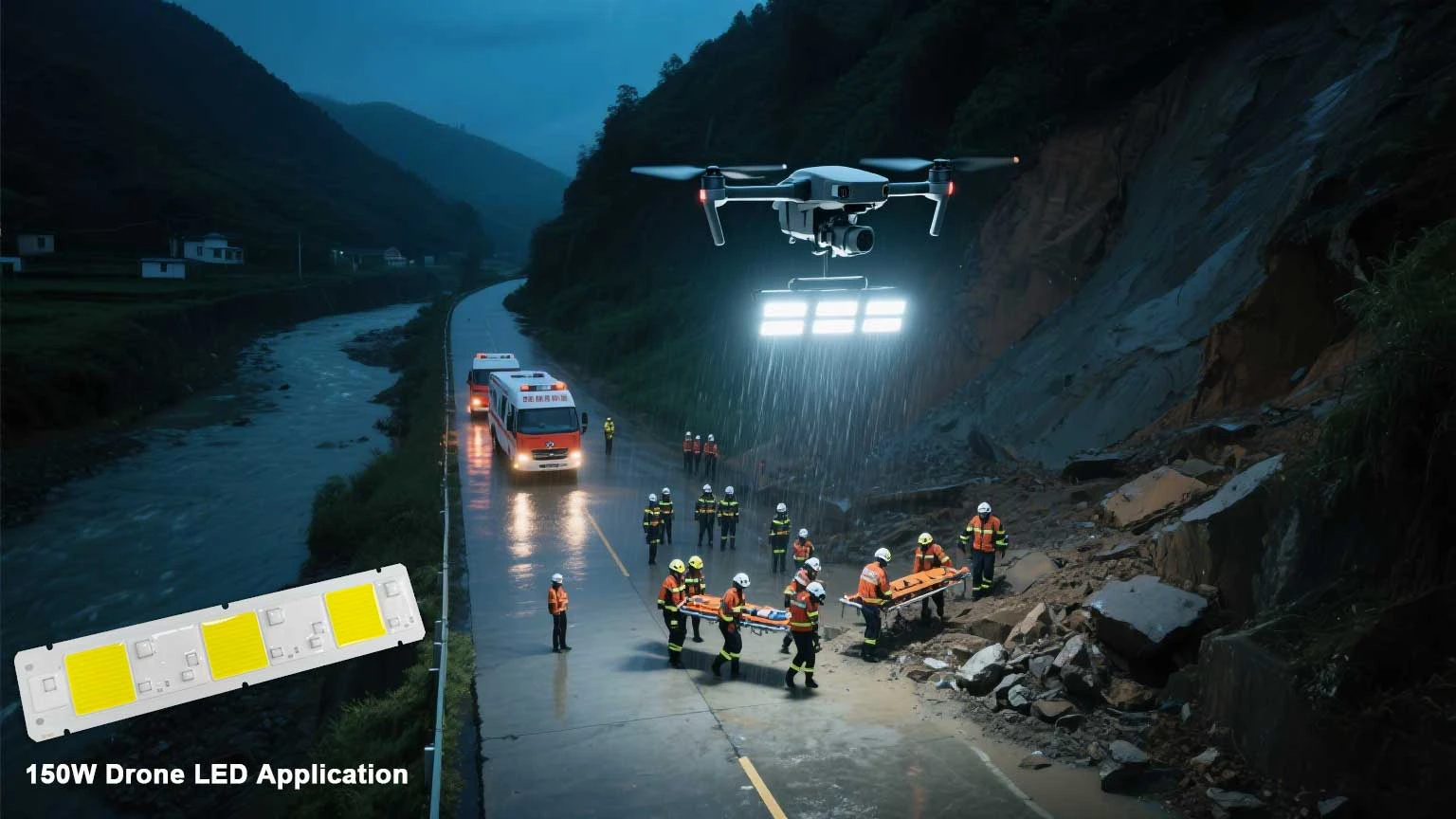
It was not from searchlights or tower chandeliers, but from the light projected from a drone flying at an altitude of 50 meters.
This is what the drone LED is doing now.
In recent years, with the popularity of industrial-grade drones, traditional ground lighting can no longer meet people's growing lighting demands.
Whether it's search and rescue in earthquake ruins and flood disasters, emergency construction on late-night sites, emergency power outage repair, or aerial lighting for movie shooting, Drone LED is becoming the new generation of "airborne lighthouse".
But lots of people still don't know:
- What is a real Drone LED?
- What are the main types of Drone LEDs in the market?
- And which scenario is each type suitable for?
- Can the drone LED be customized according to project requirements?
This article will take you on a deep understanding of the global drone lighting market, breaking down from Drone LED classification to practical applications, and focusing on analyzing the pain points and solutions currently faced by Drone LEDs. Customization is the future of Drone LEDs.
1. What is drone LED? It's not just about a simple combination of LEDs and a drone.
Many people think that drone LED is simply "assembling LEDs onto a drone".
But a real drone LED is much more than that.
It is a system-level solution that requires:
• High brightness and lightweight drone LED module
• Aviation-grade radiator structure
• Low power consumption for constant current drive circuit
• LEDs matching the power supply and control protocol with the drone platform
• Design for earthquake resistance, wind resistance, and waterproofing
In other words, not all LEDs are available to be drone LEDs.
Ordinary lighting fixtures are heavy, have poor heat dissipation, and high power consumption. If installing it on a drone not only makes the drone unstable to fly stably, but also may consume a lot of electricity, leading to power outages and crashes.
A true drone LED must be designed for aerial flight and illumination.
2. Mainstream drone LED types in the global market
According to power, LED type, and applications, the unmanned aerial vehicle LEDs currently available in the global market are mainly divided into the following categories:
1)Drone Portable light LEDs (10-50W)
• Using SMD LED chips or low-power COB LEDs, with small size, light weight, and plug-and-play functionality
• Advantages: Easy installation, suitable for consumer and light industrial drones
• Disadvantages: Limited brightness and short continuous working time
• Application scenarios: aerial photography lighting, night inspection, small-scale search and rescue
• Representative model: DJI Mavic series mounting light
🌍 Market distribution: Personal users in North America and Europe are the main focus, while security inspections are the main focus in Asia
2)High-brightness Drone searchlight LEDs (50-150W)
• Assembly with high-power COB LED and lens, with a single point of strong light, its illumination distance can reach 300-800 meters
• Advantages: Strong penetration, suitable for long-distance lighting
• Disadvantages: Small irradiation range, limited coverage area
• Application scenarios: emergency lighting, night search and rescue, border patrol
• Mostly used for industrial drones such as the DJI M300 and Matrice 350
🌍 Market distribution: Strong demand in regions with weak power infrastructure, such as the Middle East, South America, and Africa
3)Wide-angle Drone Floodlight LEDs (>200W, up to 5000W)
• Assembly with multiple SMD LED beads in an LED array or just a high-power COB LED module, with a large illumination angle (90° - 120°)
• Advantages: Large irradiation area, like a temporary "airborne lighthouse"
• Disadvantages: Large power consumption, high requirements for the battery capacity, and heat dissipation on the drone
• Generally used on medium and large tethered drones through ground tethered power supply systems
• Application scenarios: Construction site lighting, large-scale lighting at disaster sites, emergency repairs for power outages, military and police duty maintenance lighting
• Can replace traditional mobile lighting vehicles
🌍 Market distribution: Infrastructure-intensive regions such as China, India, and Southeast Asia are growing rapidly
4)Drone Photography light LEDs (adjustable color temperature, adjustable brightness, high color rendering index)
• Adopting high-power COB LED, CRI>90, color temperature adjustable from 2700K to 6500K, supporting DMX control
• Advantages: Realize "dynamic aerial fill light" to create unique visual effects
• Disadvantages: High cost, requiring a professional control team
• Application scenarios: Film and television aerial photography, outdoor stage lighting, and advertising shooting
• Collaborate with ground lighting systems
🌍 Market distribution: Hollywood, Bollywood, and other film and television production companies, high-end advertising teams, short drama and short video photography teams
5) Drone Warning Light LEDs
• Surface-mounted LED chips or high-power COB LED modules that flicker at high frequencies, such as red, blue, and yellow (such as red and blue 5Hz strobe lights)
• Advantages: Strong light penetration ability, visible from several kilometers away, even in foggy or rainy weather
• Disadvantages: Limited brightness, unable to be used as the main lighting
• Application scenarios: traffic diversion, emergency rescue, maritime rescue, ecological protection warning
• Generally used in conjunction with a dedicated long-distance loudspeaker
🌍 Market distribution: large-scale concerts in Europe and America, global earthquake/flood/tsunami rescue sites, mountain or forest search and rescue, and ecological protection
6) Other Specialty Drone Light LEDs
• Assembly with unconventional color LEDs, like special wavelength, special color SMD or COB LEDs
• Advantages: Strong targeting, specifically addressing lighting pain points in specific industries
• Disadvantages: low quantity demand, high research and development costs, long development cycle, requiring debugging with other drone-related equipment
• Application scenarios: Leakage detection of power equipment (UV LED), wildlife protection or search and rescue (Infrared LED), rescue signage and special effects projection for photography (multi-color LED), drone light show (RGB LED)
• Can be used with a dedicated long-distance loudspeaker
🌍 Market distribution: Smart city development and maritime applications in Europe, the United States, the Middle East, and other regions
3. The real advantages of drone LED lights:
Why are more and more industries using drone LEDs to replace traditional lighting?
Because it solves several bottlenecks that ground lighting cannot overcome:
✅ 1) Rapid deployment, no need for tedious wiring
Traditional lighting vehicles require installation, power connection, and debugging, which always takes several hours.
The drone LED lights can complete lighting deployment within 3 minutes, and light up immediately upon takeoff.
Actual case: During the 2023 Turkey earthquake, multiple rescue teams used drones equipped with 150W floodlights to immediately illuminate the debris field, significantly improving search and rescue efficiency.
✅ 2) Ignoring terrain restrictions, flexible and maneuverable, with comprehensive coverage
Drones can hover, move, and ascend/descend in the air, achieving 360 ° stereoscopic lighting.
Whether it's the exterior walls of high-rise buildings, the bottom of bridges, collapsed tunnels, or landslide mountains, they can all be accurately illuminated.
✅ 3) High safety, stay away from dangerous areas
Applied in scenarios where personnel find it difficult to enter, such as fires, chemical leaks, earthquakes, tsunamis, etc.;
Drones can fly into hazardous areas, provide lighting support, and ensure the safety of rescue workers.
✅ 4) Lower maintenance costs and more cost-effective for long-term use
A 300W mobile lighting vehicle costs about 5,000 to 10,000 USD and requires ongoing fuel and high maintenance costs in the later stages.
A high-performance drone LED system (including drones) costs about 7,000 to 15,000 USD, but it does not require personnel on duty, can be reused, and has low maintenance costs.
4. Pain points and solutions for drone LED
Despite its obvious advantages, drone LED also has its limitations:
❌ 1) Limited Flight Time
Currently, most drones have a flight time of 30-50 minutes, and the higher the LED power consumption is, the shorter the flight time will be.
Solution: Use battery swapping mode or ground-powered drones (tethered drones).
❌ 2) Difficulty in heat dissipation design
Although high-altitude wind speed helps with heat dissipation, high-power LEDs generate a significant amount of heat. Especially when using LEDs bonded with gold wires, due to the excessive heat generated by the internal resistance of gold wires, it will greatly consume electricity, and even lead to large light decay or LED dead light due to poor heat dissipation.
Solution: Use flip-chip COB or CSP LEDs with no gold wire bonding to perfectly solve the gold wire problem.
❌ 3) Strict requirements for weight and flight balance
• The design of drone LEDs cannot be too haphazard, and the LED structure must be optimized.
• Every gram of weight added affects flight stability and flight time.
• LED modules must achieve compact structure, lightweight, and high luminous efficiency.
Solution: Try to use the COB LED structure as much as possible to reduce the volume and weight of LED brackets. Integration is the development trend of drone LED.
❌ 4) High environmental adaptability requirements
• In high-altitude areas, the air is thin and the heat dissipation efficiency decreases;
• Dust, rain, and low temperatures can all affect the performance of drone LED;
• LEDs must pass rigorous verification such as IP67 protection, -20 ℃ low temperature start-up, and seismic testing.
Solution: Using flip-chip COB or CSP LED packaging with surface sealing and waterproof treatment, not afraid of any adverse weather conditions.
5. Why is "Customization" the future of drone LEDs?
After contacting many customers, we found that no "universal" drone LED can meet all their needs. for example:
• Firefighting customers require "high brightness + waterproofing" (rescues can encounter rainy weather);
• Film and television customers require "high color rendering + accurate color temperature range up to 100K" (otherwise, inconsistent image colors will occur);
• Electricity customers also demand "lightweight + electromagnetic interference resistance" (to prevent failure near high-voltage power lines).
So, the engineering design capability of the LED manufacturer becomes crucial.
We have been producing drone LEDs for many years, and our greatest strength lies in "following customer needs":
• Do you want to mount it on a small drone? So let's make the LED module within 200g while ensuring a brightness of 140lm/W lumens;
• Do you need to use it at sea? Then upgrade to IP68 waterproof and add anti-corrosion coating;
• If you need to use it in extremely cold regions (such as Arctic scientific expeditions), we will adjust the chip and packaging materials to ensure continued operation at -40°C.
In fact, for customers, choosing a drone LED is not just about choosing a "light", but about choosing a "solution that can solve the problem". So it is crucial to design customized LEDs based on the customer's drone lighting needs. The ability to customize is more important than the parameters themselves.

6. Customize your own drone LED
From flashlights to searchlights, from streetlights to lighting vehicles, humans have been expanding the boundaries of light.
Today, drone LEDs are allowing light to truly "fly freely".
It is not only an upgrade in technology, but also a breakthrough in thinking.
When disaster strikes, light can arrive instantly.
When construction continues late at night, light can hover over every work surface.
When the camera needs a miracle, light can draw a trajectory from the sky.
If you are looking for a truly reliable, adaptable, and problem-solving drone LED light source, don't compromise on the 'universal version' anymore.
Tell us about your scenario, your drone type, and your lighting needs.
Let us design it.
Visit WELCOB website to contact us and provide free technical consultation and drone LED solution design.
Support small batch samples, bulk delivery, ODM cooperation, and serve global customers.