


When sourcing a customized COB LED light source, providing only the required wattage and color temperature is rarely enough for an accurate technical evaluation.
A COB LED module is part of a larger lighting system. Its electrical configuration, optical output, substrate, thermal structure and mechanical dimensions all influence whether it can work properly in the intended fixture.
For lighting manufacturers, distributors and engineering companies, a detailed Request for Quotation (RFQ) helps the LED supplier understand the actual project requirements before recommending a design.
It can also reduce unnecessary communication, shorten the engineering evaluation process and minimize repeated sample modifications.
The following checklist outlines ten key details to prepare before contacting a custom COB LED manufacturer.
Why a Detailed COB LED RFQ Matters
Two COB LED modules with the same rated power may have very different designs.
For example, a 50W module intended for a compact indoor fixture may require a different board size, thermal structure and optical arrangement from a 50W module designed for an industrial lighting application.
Similarly, AC COB and DC COB LED sources have different electrical architectures and system requirements.
Without sufficient project information, a supplier may be able to provide only a preliminary recommendation rather than a complete technical proposal.
A well-prepared RFQ gives the engineering team a clearer starting point for evaluating the LED package, circuit design, PCB substrate and manufacturing process.
10 Specifications to Include in Your RFQ
1. Application and Fixture Type
Start by explaining where the LED light source will be used.
Examples include:
- Indoor commercial lighting.
- Industrial and high-bay lighting.
- Outdoor lighting.
- Fishing lights.
- Photography and video lighting.
- Horticultural lighting.
Specialized equipment or customized lighting systems.
If possible, provide a fixture drawing, reference image or description of the installation environment.
The application helps the supplier understand the expected operating conditions and identify possible design constraints.

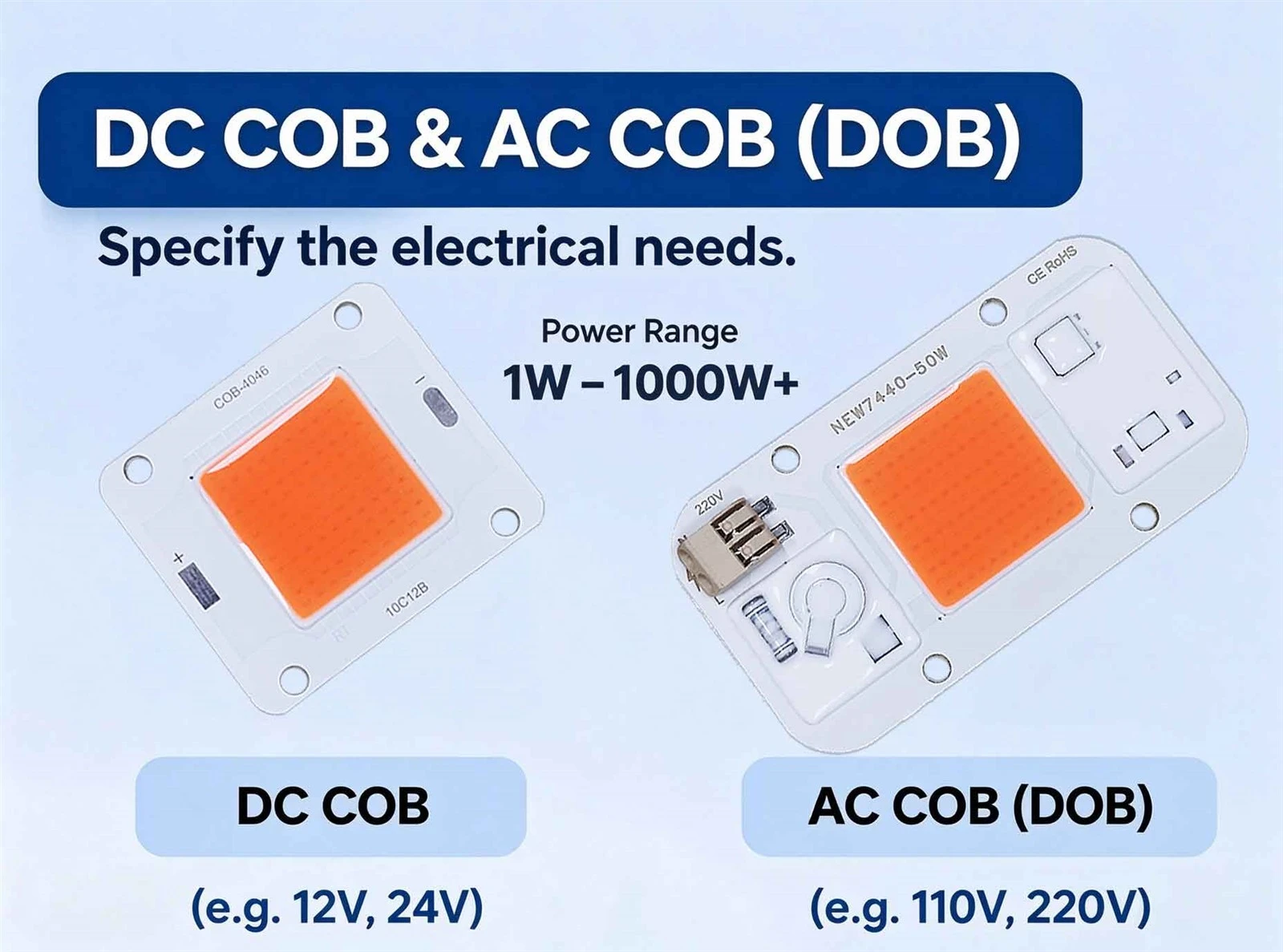
2. Input Voltage and Electrical Architecture
Specify whether the project requires a DC COB LED source or an AC COB/DOB LED module.
For a DC COB LED, provide the intended electrical operating conditions and relevant LED driver information.
For an AC COB LED, specify the required mains input conditions, such as AC110V, AC220V or another defined configuration.
If the project needs multiple input-voltage versions, state this clearly.
This distinction is important because the electrical architecture affects circuit design, component selection and system integration.
3. Rated Power
Provide the target power for each LED module or light source.
If the final fixture uses multiple LED modules, clarify whether the specified wattage refers to one module or the complete fixture.
For example, a fixture may use several lower-power COB modules connected in a parallel configuration to achieve its total rated power.
Also indicate whether the power requirement is fixed or whether alternative configurations can be evaluated.
This information helps the supplier assess chip configuration, circuit design and thermal requirements.
4. CCT, Color and CRI
Define the required light color and color quality.
For white-light applications, specify the target correlated color temperature (CCT), such as warm white, neutral white or cool white.
If color rendering is important, include the required CRI and any additional color-quality requirements.
For specialized applications, provide the required color or wavelength information rather than using general descriptions such as blue, red or full spectrum alone.
For horticultural, medical or photography projects, a spectral power distribution (SPD) reference can be especially useful.
The supplier should understand whether the project needs a fixed spectrum, multiple color channels or adjustable spectral output.
5. Optical Requirements and Emitting Area
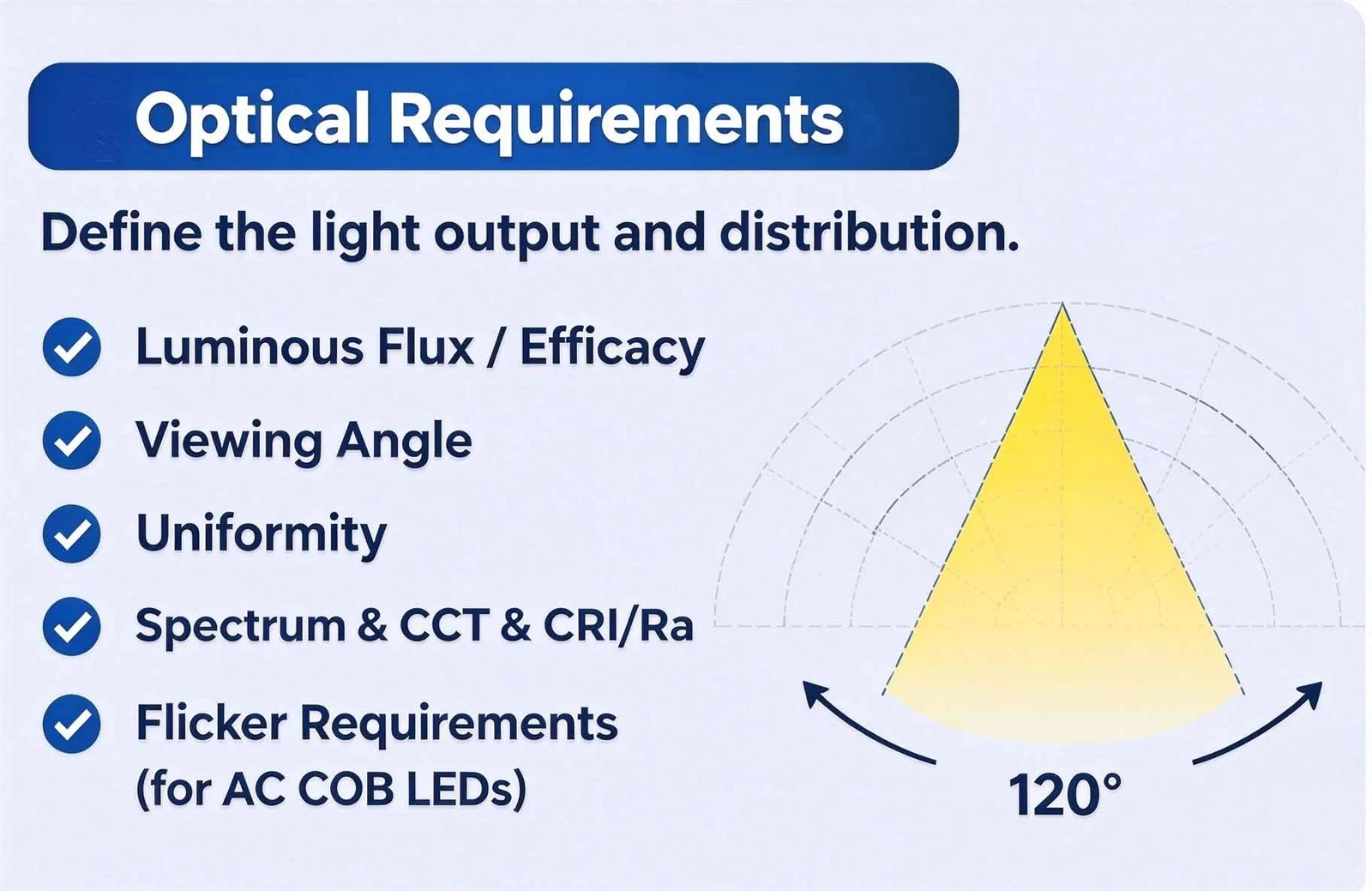
Describe the required luminous output and light distribution.
Depending on the application, relevant information may include:
- Target luminous flux or luminous efficacy.
- Emitting surface dimensions.
- LED viewing angle.
- Light distribution requirements.
- Optical arrangement, including lenses or reflectors, if applicable.
- Uniformity requirements.
- Specific wavelength or spectral characteristics.
- Flicker requirements (just for AC COB LEDs).
The physical emitting area matters because it can influence the optical design, fixture layout and thermal arrangement.
If the project has a strict space limitation, provide the maximum available emitting area and any relevant optical constraints.
6. PCB Dimensions and Mounting
Provide the required board dimensions, shape and mounting details.
Common considerations include:
- Round or rectangular PCB.
- Overall length and width or diameter.
- Board thickness.
- Mounting-hole positions.
- Component clearance.
- Connector or solder-pad locations.
For customized COB LED modules, the PCB is not simply a mechanical carrier. Its design also affects electrical routing and heat transfer.
A mechanical drawing is preferable when the module must fit into an existing fixture housing.
If the dimensions are flexible, tell the supplier which measurements are fixed and which can be optimized.

7. Substrate and Thermal Design
Thermal management is one of the most important considerations in high-power COB LED development.
Specify the intended heat-sink arrangement, available installation space and any known thermal limitations.
Depending on the application and design requirements, the supplier may evaluate different substrate options, including aluminum, copper or ceramic-based solutions.
The appropriate choice depends on electrical, mechanical and thermal requirements rather than material selection alone.
If you already have a fixture prototype, providing its heat-sink drawing or thermal structure can help the engineering team assess the complete thermal path.
Avoid evaluating the COB LED source separately from its actual operating environment.

8. Electrical Connections
Define how the module will connect to the lighting system.
Possible requirements include:
- Solder pads.
- Wire connections.
- Terminal connectors.
- Connector position and orientation.
- Separate input and output interfaces.
- Parallel connection requirements.
For modular lighting systems, also explain whether multiple LED modules need to be connected together.
A clear electrical interface specification helps prevent problems during fixture assembly and simplifies later production integration.
9. Dimming and Control Requirements
If the finished lighting product requires dimming or color adjustment, describe the expected control method.
For example, the project may require:
- On/off operation.
- PWM dimming.
- Potentiometer-based dimming (integrated or external).
- 0-10V dimming.
- TRIAC (phase-cut) dimming, where applicable.
- Multi-channel color adjustment.
- CCT tuning.
- Intelligent spectrum control.
Do not assume that every COB LED module supports every dimming method.
The LED source, driver or AC control circuit, and external dimmer or controller must be evaluated as a complete system.
For customized projects, provide the relevant control-system information or an existing electrical diagram whenever possible.
10. Operating Environment and Compliance
Finally, describe the actual working environment and target market.
Important details may include:
- Indoor or outdoor installation.
- Ambient temperature.
- Moisture or water exposure.
- Vibration requirements.
- Dust exposure.
- Expected operating hours.
- Applicable regional compliance requirements.
If the application requires waterproofing, potting or additional protection, specify the intended protection level and operating conditions.
For products sold into regulated markets, identify the applicable standards or certification requirements at the beginning of the project.
The supplier can then assess whether the proposed module design and available documentation are suitable for further testing.
What Happens After an RFQ Is Submitted?
A customized COB LED project generally requires more than a price quotation.
Once the supplier receives the project requirements, the engineering team can review the electrical configuration, chip arrangement, packaging process, substrate and thermal design.
A typical development workflow includes:
- Requirement review: Evaluate the customer's electrical, optical, dimensional, mounting and application requirements.
- Engineering assessment: Review chip configuration, COB packaging process, PCB design and thermal considerations.
- Prototype development: Prepare samples based on the agreed specifications.
- Sample evaluation: Check relevant electrical, optical and thermal performance.
- Application verification: Evaluate the module in the customer's actual fixture or lighting system.
- Pilot and mass production: Proceed after the design and acceptance criteria are confirmed.
The exact process depends on project complexity, customization requirements and sample availability.
How to Make Your Custom COB LED Project More Efficient
A clear RFQ helps both the customer and the manufacturer work toward the same technical target.
Instead of sending only a wattage requirement, provide a specification sheet, mechanical drawing, reference product or fixture information whenever possible.
If some parameters have not yet been finalized, identify them as open items rather than guessing.
An experienced COB LED packaging manufacturer can then evaluate the available options and identify which requirements need further engineering discussion.
For lighting manufacturers and distributors seeking a long-term supplier, this early technical communication is an important step toward stable product development and production.
A good RFQ does not need to contain every final design detail. It needs to provide enough accurate information for the supplier to evaluate the project and recommend the next engineering step.
Suggested FAQs
Q1: What information does a COB LED manufacturer need for a quotation?
A1: At minimum, provide the application, input voltage, rated power, CCT or color, CRI requirements, PCB dimensions and expected quantity. More complex projects should also include thermal, optical, certification and environmental requirements.
Q2: Can a COB LED manufacturer customize the PCB dimensions and electrical connections?
A2: Customization may be possible depending on the project requirements and manufacturing capabilities. Buyers should provide mechanical drawings and connection details for engineering evaluation.
Q3: Should I request samples before finalizing all specifications?
A3: Samples can help evaluate a proposed design, but key electrical, optical, dimensional and thermal requirements should be defined first. Any specifications that have not yet been finalized should be clearly identified to avoid unnecessary prototype revisions.
Q4: What does WELCOB specialize in?
A4: WELCOB is a Shenzhen-based COB LED and DOB LED packaging manufacturer specializing in high-power DC COB and AC COB LED light sources. We offer multiple LED design configurations and thermal management solutions for high-thermal-density applications, including fishing lights, photography lights, drone lights and stage lighting.
Q5: Why choose WELCOB for custom high-power COB LED solutions?
A5: WELCOB focuses on solving thermal management challenges in high-power, high-thermal-density LED light sources. By combining flip-chip, wire-bond-free packaging technology, customized PCB design and various COB packaging processes, we develop DC and AC COB LED solutions tailored to demanding lighting applications. Our focus is on helping lighting manufacturers achieve compact designs, optimized thermal performance and reliable production integration.
Q6: Can WELCOB provide different design solutions for high-power DC COB and AC COB LEDs?
A6: Yes. WELCOB offers customized DC COB and AC COB (DOB) LED solutions with different power ratings, input voltages, chip configurations, emitting areas, PCB substrates and thermal structures. Our engineering team evaluates the application and fixture requirements to recommend suitable configurations for each project.
Q7: Does WELCOB support bulk orders for customized COB LED products?
A7: Yes. WELCOB focuses on B2B projects for lighting manufacturers, trading companies, distributors and engineering companies. We support customized LED light source development from engineering evaluation and prototype sampling to pilot runs and mass production. Order quantities and production arrangements are evaluated according to project requirements.
