


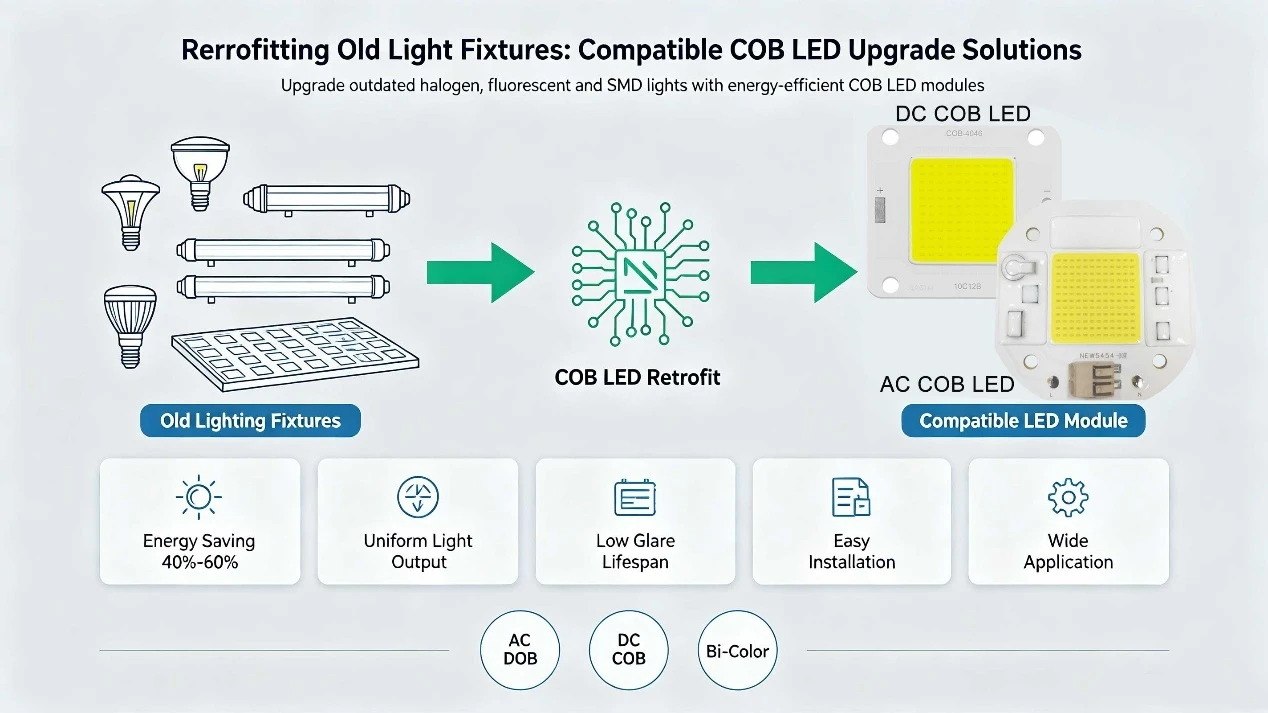
Many lighting manufacturers, facility engineers, and retrofit contractors face the challenge of updating aging lighting systems. Older fixtures often rely on halogen, fluorescent, or early SMD LED sources that deliver poor efficiency, high maintenance costs, and inconsistent performance. COB LEDs provide a practical upgrade path, delivering higher lumen output, better uniformity, and lower energy use while fitting many existing housings.
This guide outlines key considerations for successful retrofits, common compatibility options, and technical factors to evaluate.
Why Consider COB LED Retrofits?
Facilities and OEMs upgrade for several clear reasons:
• Energy savings: Modern COB modules often achieve higher efficacy (lumens per watt) than legacy sources.
• Improved light quality: Better color consistency and higher CRI reduce visual fatigue in commercial or industrial spaces.
• Lower maintenance: Longer rated lifetimes and fewer components cut replacement frequency.
• No glare: COB LEDs feature a single, large light-emitting surface that produces soft, diffused illumination. This significantly reduces glare compared to multi-point SMD arrays or point-source legacy lamps, making them suitable for offices, schools, hospitals, and other environments where visual comfort is essential. The even photon distribution minimizes direct brightness contrast that can cause eye strain.
• Uniform light emission, no hotspots: The dense chip array in COB designs creates a continuous, homogeneous light output across the entire emitting area. Unlike traditional sources that often produce visible spots, rings, or uneven patches, COB delivers smooth beam patterns and consistent intensity. This improves overall lighting uniformity (high UGR values), enhances visual tasks, and simplifies optical design in retrofits without needing complex diffusers or additional lenses.
• Form factor flexibility: COB's compact light emitting surface (LES) works well in spot, flood, and linear fixtures.
Key Compatibility Factors for Upgrades
Successful retrofits depend on matching electrical, mechanical, and thermal requirements.
1. Driver and Voltage Compatibility
Before retrofitting, it is essential to verify the optoelectronic parameters of the original light source. These include-but are not limited to-forward operating voltage, current, power, and dimming capabilities (including protocols such as 0-10V, DALI, or phase-cut dimming).
Two LED Light Source Options:
1) DC COB LEDs (typically 12V, 24V, or 36V): Suitable for existing low-voltage systems or constant-current drivers. You must determine whether the system requires constant-voltage or constant-current driving before selecting a compatible power supply.
2) AC COB or DOB (Driver-on-Board) modules integrate the driver directly onto the circuit board, simplifying wiring for mains-voltage (AC110V or AC220V) luminaires and reducing component counts and potential points of failure.
2. Physical Dimensions and Mounting
Measure the original light engine's board size, cutout diameter, and height. Popular COB sizes (e.g., 20-50mm LES) often fit standard reflectors and heat sinks.
• If using a reflector or lens, pay attention to its compatibility with the LED board; otherwise, it may not be possible to mount or use them together.
3. Thermal Management COB LEDs run efficiently but still require adequate heat sinking. Assess the fixture's existing thermal path and add TIM (thermal interface material, such as thermal grease) if needed. To ensure optimal service life, the steady-state operating temperature of the heat sink should be maintained below 85°C.
4. Optical Performance
• Choose CCT (2700K-6500K) and CRI (Ra 80-95+) based on the application.
• Bi-color or RGBCW COB modules enable tunable output for spaces needing variable scenes, such as retail or conference areas.
• Full spectrum and horticultural COB suit grow light retrofits where accurate PAR/PPFD matters.
Popular Retrofit Applications and Product Matches
• Commercial Downlights & Troffers: DC or AC COB modules with medium LES deliver uniform illumination and easy drop-in replacement.
• High Bay & Industrial: Higher wattage COB (50W+) with robust thermal design upgrade metal halide fixtures effectively.
• Photography / Studio: High CRI tunable COB ensures accurate color rendering without major fixture redesign.
• Outdoor / Landscape: Sealed COB upgrades floodlights with better efficacy and lower glare.
• Specialty: IR COB for security retrofits, UV COB for disinfection stations, or smart PCBA-integrated COB for IoT-enabled controls.
Step-by-Step Retrofit Process
- Audit existing fixtures: Document voltage, wattage, dimensions, and light distribution(with reflectors/lenses or not).
- Define performance goals: Target lumen output, efficacy, CRI, and lifetime.
- Select COB type: Match voltage (DC/AC), size, and spectrum to the application.
- Test prototypes: Verify thermal performance, light levels, and compatibility.
- Scale implementation: Standardize SKUs for volume procurement and consistent quality.
Expected Benefits in Practice
Retrofits commonly yield 40-60% energy reduction depending on the baseline technology, along with improved uniformity and reduced heat load. Many projects achieve payback within 2-3 years through lower utility and maintenance costs.
For engineers working on multiple fixture types, modular COB platforms with standard mounting patterns speed up design cycles and simplify inventory.
Ready to explore upgrade options for your fixtures?
Share your project details - fixture type, current wattage, target specifications, or quantity needs - and our team will provide compatible COB LED recommendations, datasheets, and pricing. Send your inquiry today for tailored support on DC COB, AC DOB, bi-color, full spectrum, or other configurations.