


Meta Description:
Not all full-spectrum LEDs deliver the wavelengths plants actually need. Discover why red 660nm and UV-A 395nm matter-and how advanced COB + SMD designs are closing the gap.
The Myth of "Sun-Like" Light in Horticulture
Walk into any grow shop or browse online, and you'll see countless LED fixtures labeled "full-spectrum." Many claim to mimic sunlight, promising lush growth from seed to harvest.
But here's an inconvenient truth: most so-called full-spectrum LEDs are missing critical spectral components that plants rely on for robust development, flowering, and secondary metabolite production.
Sure, they cover the basics-blue for veg, red for bloom-but what about the nuances? The subtle peaks and valleys in the solar spectrum that trigger photomorphogenic responses, enhance terpene synthesis, or strengthen plant immunity?
Two gaps stand out:
- Insufficient deep red (660nm) – the most photosynthetically efficient wavelength.
- Lack of UV-A (380–400nm) – a key regulator of flavonoid and anthocyanin production.
Without these, even high-CRI white LEDs fall short of true biological completeness.
Why 660nm Red Matters More Than You Think
While broad-spectrum white light includes some red, it's often diluted across a wide range (600–700nm). But chlorophyll a absorbs most efficiently at 660nm-a narrow peak where photons drive photosynthesis with maximum quantum yield.
Dedicated 660nm diodes (like SMD3030 chips) deliver this exact wavelength at high intensity, significantly boosting:
- Flowering density
- Stem strength
- Overall PAR efficiency
In research trials, adding just 10–15% 660nm to white spectra has increased yields by 15–25% in crops like tomatoes, cannabis, and leafy greens.
The Overlooked Power of UV-A (395nm)
Then there's ultraviolet. While UV-B (280–315nm) is risky and requires careful dosing, UV-A around 395nm is safe, controllable, and highly beneficial.
At this wavelength, plants activate defense pathways that lead to:
- Higher antioxidant levels
- Richer pigmentation (think purple basil or red lettuce)
- Improved aroma and flavor profiles
Yet, standard phosphor-converted COB or white LEDs emit virtually no UV-A. It simply isn't part of their spectral output.
So, What Does a Truly Full-Spectrum LED Look Like?
It's not about cramming in every color. It's about strategic spectral integration:
- A high-quality COB as the foundation-delivering smooth, continuous visible light (380–780nm) with excellent CRI (>85) for visual assessment and balanced growth.
- Discrete 660nm SMD3030 LEDs to amplify photosynthetic efficiency at the peak absorption band.
- Targeted 395nm UV-A diodes to stimulate secondary metabolism without risking photodamage.
This hybrid approach combines the best of both worlds: the uniformity and simplicity of COB with the precision of monochromatic SMDs.
And when the COB uses flip-chip technology, you gain superior thermal performance-critical for maintaining spectrum stability and longevity in high-power horticultural fixtures.
One Design That Gets It Right
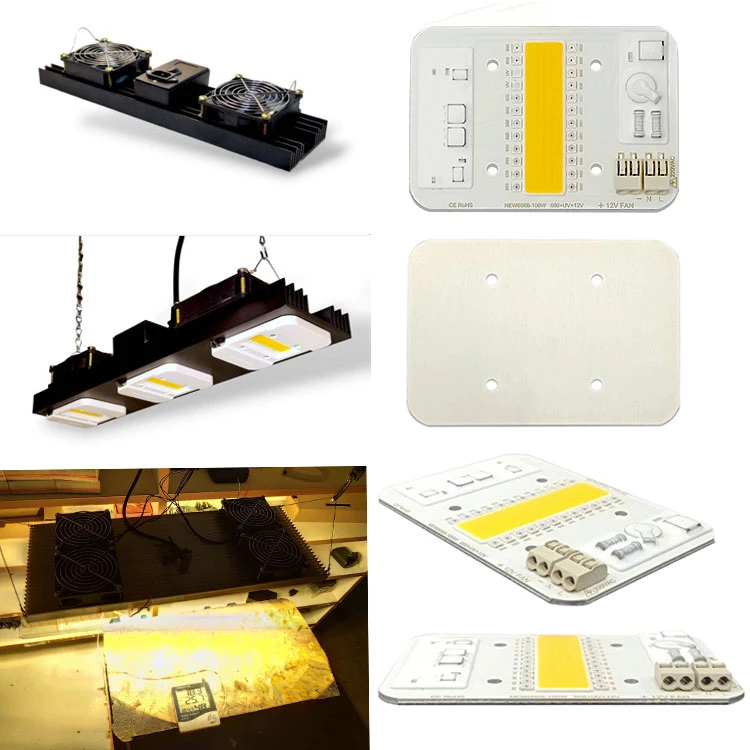
After evaluating dozens of modules for our customers, we recently integrated a COB+SMD LED solution that stands out for its thoughtful engineering: the WELCOB HP6088-220-100W-660+UV+12V.
What makes it different?
- Flip-chip COB core (3500K) for stable, continuous full-spectrum output
- High output 660nm SMD3030 chip enhances red light ratio and improves photosynthetic efficiency
- 395nm UV-A diodes for metabolic activation
- Direct AC 220–240V operation-no external driver needed
- Built in DC 12V output terminal, supports connecting DC 12V fans, optimizes lamp structure, and improves power conversion efficiency
- 4kV surge protection and IP-rated sealing for harsh environments
More importantly, it doesn't just claim to be full-spectrum-it delivers biologically relevant light across the entire PAR and beyond.
For growers who demand spectral accuracy, thermal reliability, and simplified system design, this kind of integrated module represents a meaningful step forward.
When your LEDs include the right red, the right UV, and a stable, sun-like continuum in between, you're not just growing plants.You're cultivating quality.
Are you ready to try to use COB+SMD type of full spectrum LED? If you have a better full spectrum LED design solution, we would be happy to hear your opinions. Please contact us for further discussion!